About Coins - Complete Guide

Coin Structures

Understanding the basic structures and anatomy of coins is fundamental for numismatists. Each coin has specific components that define its design and functionality.

1. Obverse (Front Side)

Primary Face

The obverse, commonly called the "heads" side, typically features:
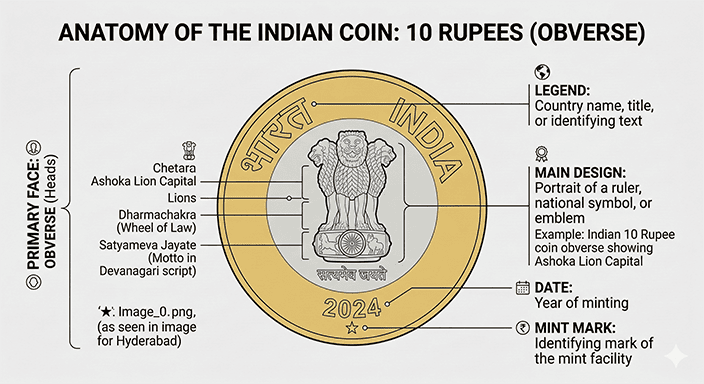
Main Design: Portrait of a ruler, national symbol, or emblem
Legend: Country name, title, or identifying text
Date: Year of minting (if present)
Mint Mark: Identifying mark of the mint facility
Coin Obverse Example
Example: Indian 10 Rupee coin obverse showing Ashoka Lion Capital

2. Reverse (Back Side)

Secondary Face
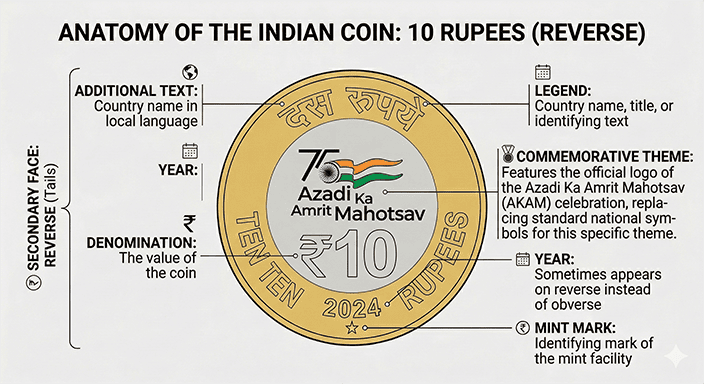
Coin Reverse Example
Example: Indian 10 Rupee coin reverse showing denomination

The reverse, commonly called the "tails" side, typically features:

Denomination: The value of the coin
Secondary Design: National symbols, commemorative themes
Additional Text: Country name in local language
Year: Sometimes appears on reverse instead of obverse

3. Edge (Third Side)

Circumference

The edge is the "third side" of the coin and can have various treatments:

Plain Edge

Smooth, undecorated edge

Reeded Edge

Vertical lines around circumference

Lettered Edge

Text inscribed on the edge

Segmented Edge

Alternating smooth and reeded sections
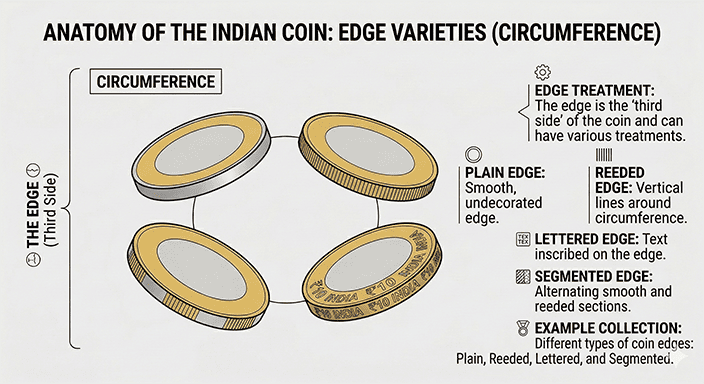
Coin Edge Types
Different types of coin edges: Plain, Reeded, and Lettered

Physical Characteristics of Coins

Coins have various physical features that serve both functional and aesthetic purposes. Understanding these characteristics is essential for proper identification and authentication.

Coin Anatomy Diagram

Detailed Coin Anatomy

Edges

The edge of a coin serves multiple purposes including security, aesthetics, and functionality. Different patterns have been developed over centuries to prevent clipping and counterfeiting.

Edge varieties help detailed identification.

Main Types of Coin Edges
Plain (Smooth)

Desc: No markings, smooth.

Purpose: Low cost.

Ex: Copper coins.

Reeded

Desc: Vertical grooves.

Purpose: Anti-shaving.

Ex: Silver coins, ₹10.

Lettered

Desc: Engraved text.

Purpose: Anti-counterfeit.

Ex: UK/US coins.

Decorated

Desc: Repeating symbols.

Purpose: Security/Design.

Ex: Euro coins.

Security

Desc: Mixed smooth/reeded.

Purpose: Machine readable.

Ex: Bi-metal coins.

Less Common / Historical Edge Types
Incuse

Desc: Sunken lettering.

Ex: Ancient issues.

Beaded

Desc: Raised dots.

Ex: Hammered coins.

Square

Desc: Flat, sharp edge.

Ex: Early machine coins.

Wire

Desc: Thin raised rim.

Note: Minting defect.
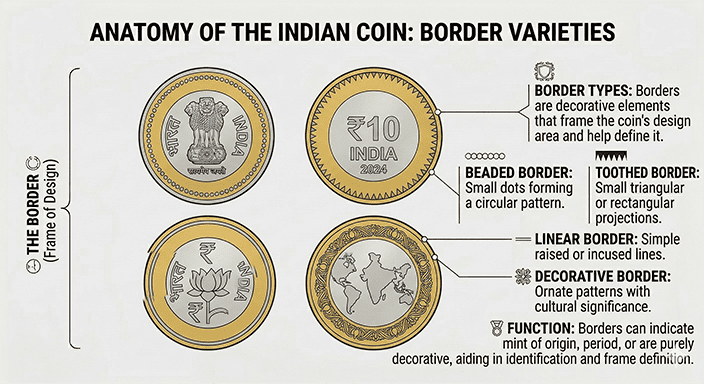
Borders

Coin Border Types
Various border styles on coins

Borders are decorative elements that frame the coin's design:

  • Beaded Border: Small dots forming a circular pattern
  • Toothed Border: Small triangular or rectangular projections
  • Linear Border: Simple raised or incused lines
  • Decorative Border: Ornate patterns with cultural significance

Borders help define the coin's design area and can indicate the mint of origin or period of production.

Legends

Legends are the text inscriptions on coins, providing crucial information:

Primary Legend

Main text identifying the issuing authority, ruler, or country name.

Secondary Legend

Additional information such as titles, mottos, or religious inscriptions.

Denomination Legend

Text indicating the value of the coin, often in multiple languages.

Reading Direction: Legends can read clockwise, counterclockwise, or in straight lines depending on the coin's design.
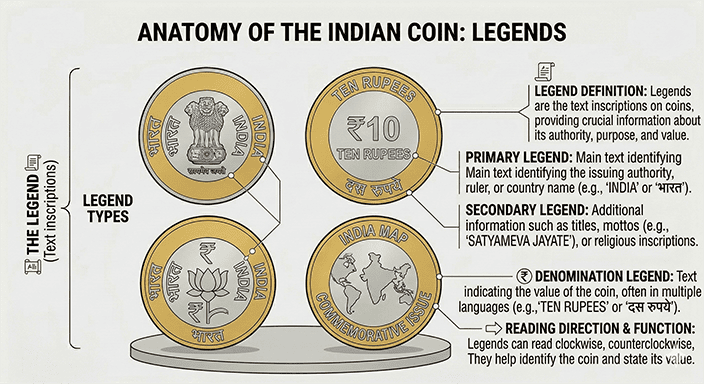
Coin Legend Examples
Examples of different legend styles and languages

Fields

The field is the flat, background area of the coin surrounding the main design elements:

  • Plain Field: Smooth, undecorated background
  • Textured Field: Surfaces with patterns or textures
  • Proof Field: Mirror-like finish for special coins

Field quality is important for coin grading and can affect the overall appearance and value.
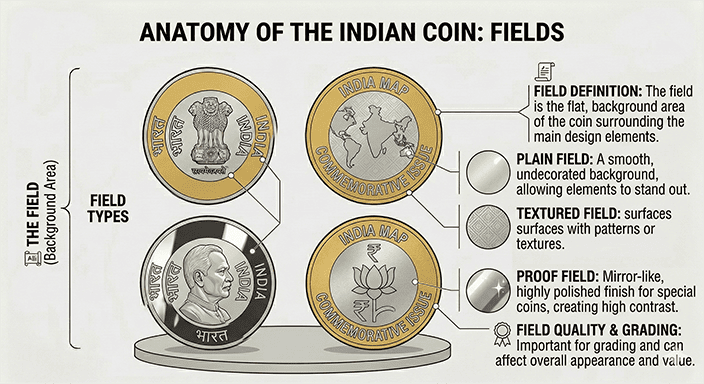
Coin Field Examples
Different field treatments and finishes

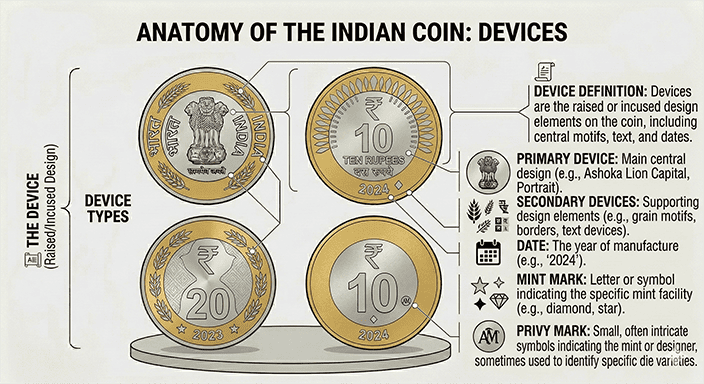
Devices

Coin Device Examples
Various devices and design elements on coins

Devices are the raised or incused design elements on the coin:

  • Primary Device: Main central design (portrait, symbol)
  • Secondary Devices: Supporting design elements
  • Privy Marks: Small symbols indicating mint or designer
  • Date: Year of manufacture
  • Mint Mark: Letter or symbol indicating mint facility

Metal Composition of Coins

The metal composition of coins has evolved throughout history, influenced by availability, cost, durability, and economic factors. Understanding these compositions helps in identification, authentication, and valuation.

Metal / Alloy Composition Period of Use
Gold ≈ 91.67% Gold + ≈ 8.33% Copper (11/12 fineness) British Period
Silver ≈ 91.67% Silver + ≈ 8.33% Copper (11/12 fineness) British Period
Quaternary Alloy 50% Silver + 40% Copper + 5% Nickel + 5% Zinc British Period
Cupro-Nickel Alloy 75% Copper + 25% Nickel British Period
Nickel 100% Nickel British Period
Nickel-Brass Alloy 79% Copper + 20% Zinc + 1% Nickel British Period
Copper ~95–98% Copper (balance trace impurities) 1835 – 1906
Bronze (Type I) 95% Copper + 4% Tin + 1% Zinc 1906 – 1936
Bronze (Type II) 95.5% Copper + 3% Tin + 1.5% Zinc 1936 – 1943
Bronze (Type III) 97% Copper + 2.5% Zinc + 0.5% Tin From 1943

Evolution of Coin Metals

Historically, coins progressed from precious metals (gold, silver) to base metals (copper, nickel) and modern alloys. This evolution reflects economic changes and technological advances in metallurgy.
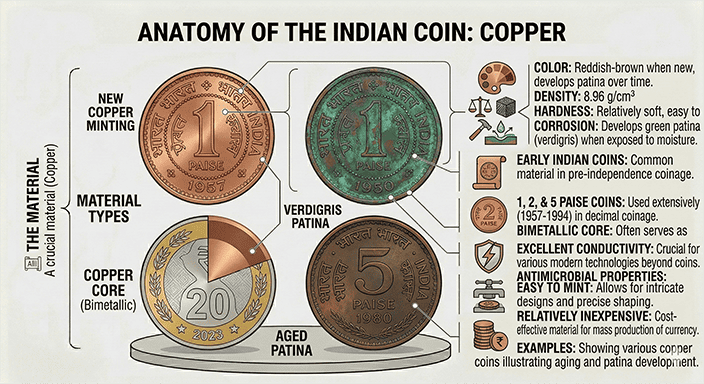
Copper

Properties:

  • Color: Reddish-brown when new, develops patina over time
  • Density: 8.96 g/cm³
  • Hardness: Relatively soft, easy to work
  • Corrosion: Develops green patina (verdigris) when exposed to moisture

Usage in Indian Coins:

  • Early Indian coins (pre-independence)
  • 1, 2, and 5 paise coins (1957-1994)
  • Core material in bimetallic coins

Advantages:

  • Excellent electrical conductivity
  • Antimicrobial properties
  • Easy to mint and shape
  • Relatively inexpensive
Copper Coins
Examples of copper coins showing aging and patina

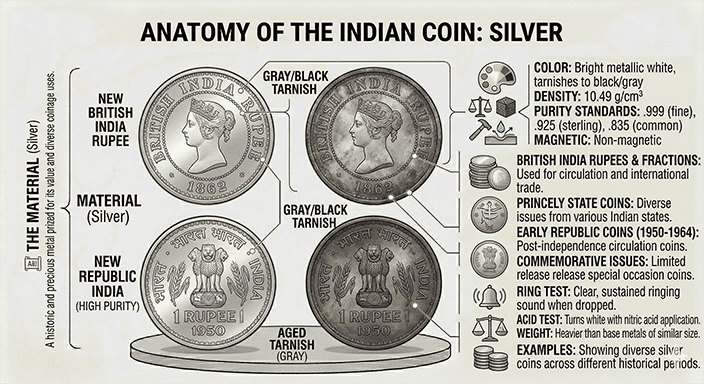
Silver

Silver Coins
Silver coins from different periods

Properties:

  • Color: Bright metallic white, tarnishes to black/gray
  • Density: 10.49 g/cm³
  • Purity Standards: .999 (fine), .925 (sterling), .835 (common)
  • Magnetic: Non-magnetic

Historical Usage:

  • British India rupees and fractions
  • Princely state coins
  • Early Republic of India coins (1950-1964)
  • Commemorative coins (limited issues)

Identification:

  • Ring test: Clear, sustained ringing sound
  • Acid test: Turns white with nitric acid
  • Weight: Heavier than base metals

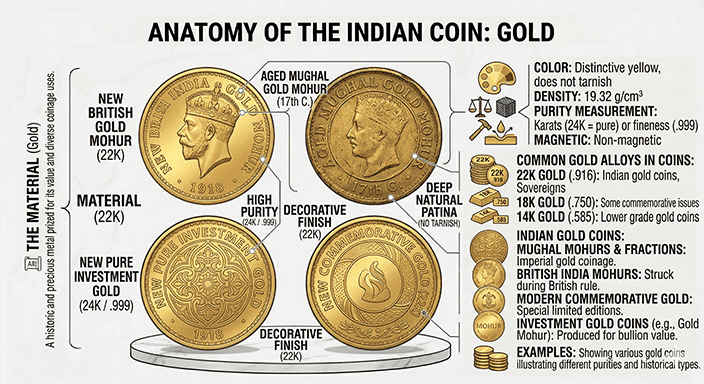
Gold

Properties:

  • Color: Distinctive yellow, does not tarnish
  • Density: 19.32 g/cm³
  • Purity Measured in: Karats (24K = pure) or fineness (.999)
  • Magnetic: Non-magnetic

Common Gold Alloys in Coins:

  • 22K Gold (.916): Indian gold coins, Sovereigns
  • 18K Gold (.750): Some commemorative issues
  • 14K Gold (.585): Lower grade gold coins

Indian Gold Coins:

  • Mughal mohurs and fractions
  • British India mohurs
  • Modern commemorative gold coins
  • Investment gold coins (like Gold Mohur)
Gold Coins
Various gold coins showing different purities

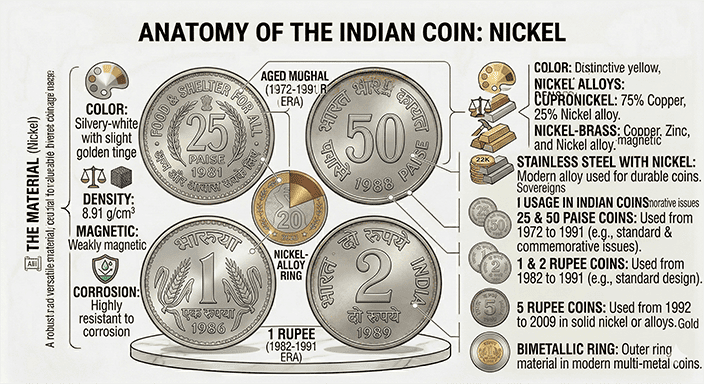
Nickel

Nickel Coins
Nickel and nickel-alloy coins

Properties:

  • Color: Silvery-white with slight golden tinge
  • Density: 8.91 g/cm³
  • Magnetic: Weakly magnetic
  • Corrosion: Highly resistant to corrosion

Nickel Alloys:

  • Cupronickel: 75% copper, 25% nickel
  • Nickel-brass: Copper, zinc, and nickel
  • Stainless steel with nickel: Modern alloy

Usage in Indian Coins:

  • 25 paise, 50 paise coins (1972-1991)
  • 1 and 2 rupee coins (1982-1991)
  • 5 rupee coins (1992-2009)
  • Ring material in bimetallic coins

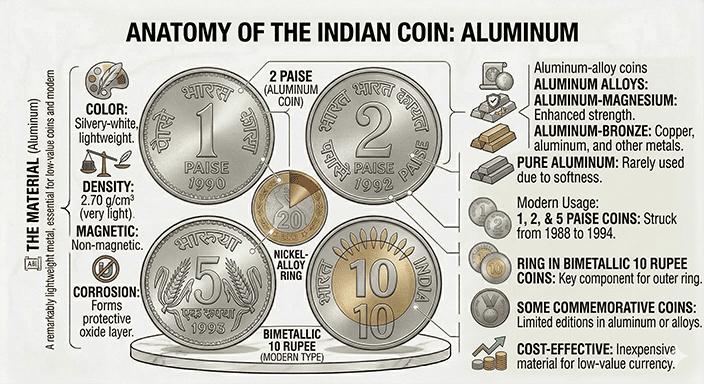
Aluminum

Properties:

  • Color: Silvery-white, lightweight
  • Density: 2.70 g/cm³ (very light)
  • Magnetic: Non-magnetic
  • Corrosion: Forms protective oxide layer

Aluminum Alloys:

  • Aluminum-Magnesium: Enhanced strength
  • Aluminum-Bronze: Copper, aluminum, and other metals
  • Pure Aluminum: Rarely used due to softness

Modern Usage:

  • 1, 2, 5 paise coins (1988-1994)
  • Ring in bimetallic 10 rupee coins
  • Some commemorative coins
  • Cost-effective for low denomination
Aluminum Coins
Aluminum coins showing lightweight characteristics

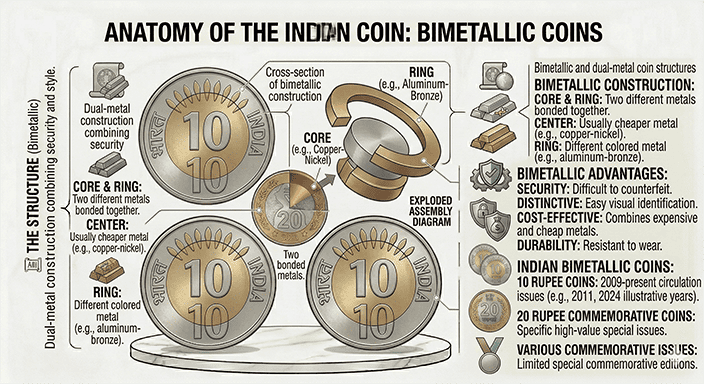
Bimetallic Coins

Bimetallic Coins
Cross-section of bimetallic coin construction

Construction:

  • Core and Ring: Two different metals bonded together
  • Center: Usually cheaper metal (copper-nickel)
  • Ring: Different colored metal (aluminum-bronze)

Advantages:

  • Security: Difficult to counterfeit
  • Distinctive: Easy visual identification
  • Cost-effective: Combines expensive and cheap metals
  • Durability: Resistant to wear

Indian Bimetallic Coins:

  • 10 rupee coins (2009-present)
  • 20 rupee commemorative coins
  • Various commemorative issues

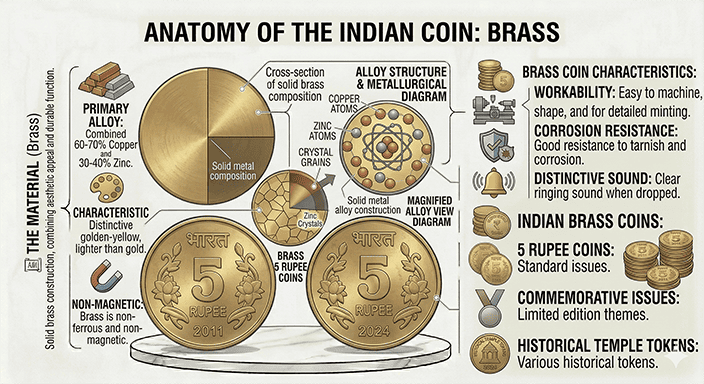
Brass

Composition:

  • Primary: Copper (60-70%) and Zinc (30-40%)
  • Variations: May include small amounts of other metals
  • Color: Golden-yellow, similar to gold but lighter

Properties:

  • Workability: Easy to machine and shape
  • Corrosion: Good resistance to corrosion
  • Magnetic: Non-magnetic
  • Sound: Distinctive ringing when dropped

Usage:

  • 5 rupee coins (2009-present)
  • Some commemorative coins
  • Historical temple tokens
Brass Coins
Brass coins showing golden color

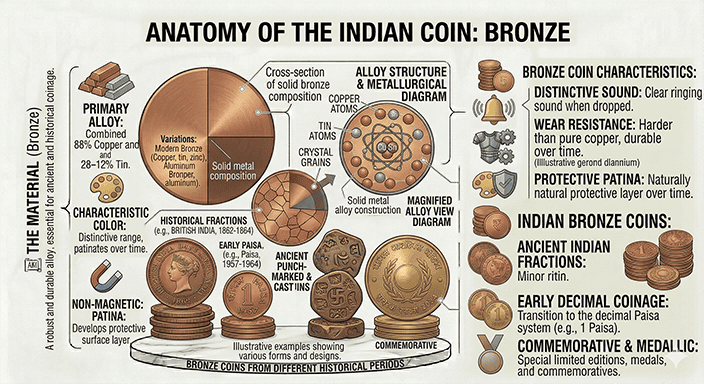
Bronze

Bronze Coins
Bronze coins from different periods

Composition:

  • Traditional: Copper (88%) and Tin (12%)
  • Modern: Copper, tin, and zinc in various proportions
  • Aluminum Bronze: Copper and aluminum

Properties:

  • Color: Reddish-brown to golden-brown
  • Hardness: Harder than pure copper
  • Durability: Excellent wear resistance
  • Patina: Develops protective surface layer

Historical Significance:

  • Ancient Indian coins
  • British India fractional coins
  • Early decimal coinage
  • Commemorative and medallic issues

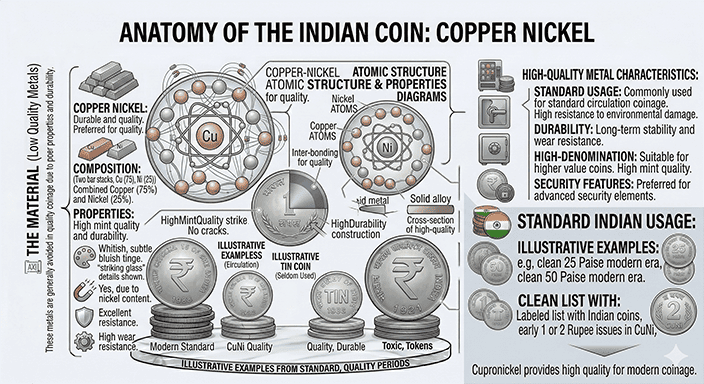
Copper Nickel

Copper Nickel Coins

Composition:

  • Copper: 75%
  • Nickel: 25%

Properties:

  • Magnetic: Yes, due to nickel content
  • Color: Whitish, little bluish tinged with striking glass
  • Corrosion: Excellent resistance
  • Durability: High wear resistance

Usage:

  • Modern circulation coins worldwide
  • Suitable for high-denomination coins
  • Preferred for security features

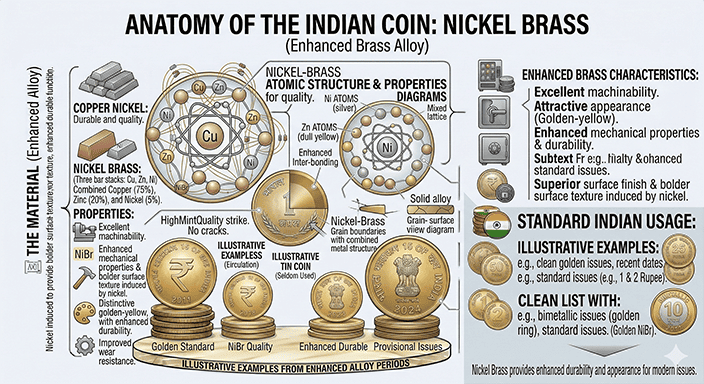
Nickel Brass

Composition:

  • Copper: 75%
  • Zinc: 20%
  • Nickel: 5%

Properties:

  • Purpose: Nickel induced to provide bolder surface texture
  • Color: Golden-yellow with enhanced durability
  • Workability: Excellent machinability
  • Strength: Enhanced mechanical properties

Advantages:

  • Superior surface finish
  • Improved wear resistance
  • Attractive appearance
Nickel Brass Coins

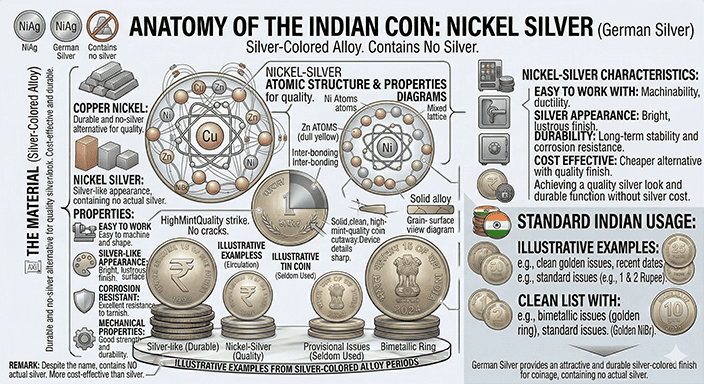
Nickel Silver (German Silver)

Nickel Silver Coins

Composition:

  • Copper: 60%
  • Nickel: 20%
  • Zinc: 20%

Important Note:

  • Contains No Silver: Despite the name
  • Alternative Name: German Silver
  • Appearance: Silver-like color
  • Cost: Much cheaper than actual silver

Properties:

  • Corrosion resistant
  • Good mechanical properties
  • Easy to work with

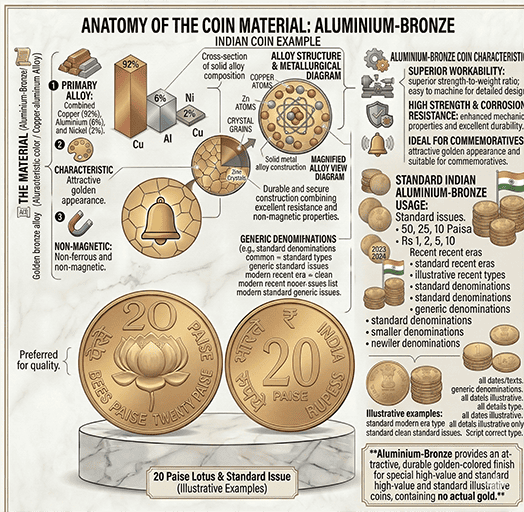
Aluminium-Bronze

Aluminum Bronze Coins

Composition:

  • Copper: 92%
  • Aluminium: 6%
  • Nickel: 2%

Properties:

  • Color: Golden color
  • Classification: Alloy of Copper
  • Strength: Enhanced mechanical properties
  • Corrosion: Excellent resistance

Advantages:

  • Attractive golden appearance
  • Superior strength-to-weight ratio
  • Ideal for commemorative coins

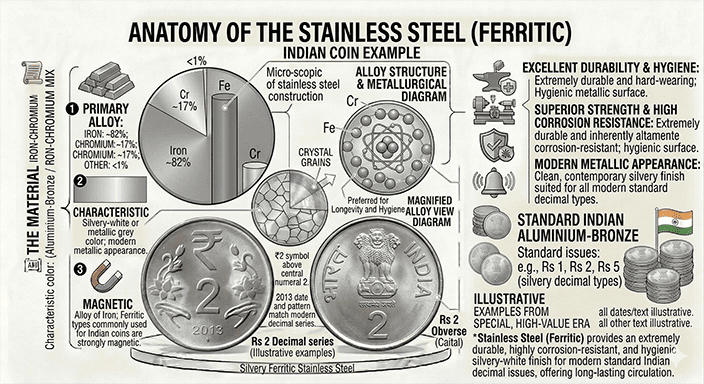
Ferritic Stainless Steel (FSS)

Composition:

  • Iron: 83%
  • Chromium: 17%

Properties:

  • Corrosion Protection: Chromium protects coinage from corrosion
  • Magnetic: Yes, due to iron content
  • Durability: Extremely long-lasting
  • Cost: Economical for mass production

Modern Usage:

  • Contemporary circulation coins
  • Replacement for traditional alloys
  • Suitable for harsh environments
Ferritic Stainless Steel Coins

Comprehensive Silver Information

Silver Content Classifications:

  • High Silver (>50%): 80% / 91.74% / 91.66% / 92.5% silver, remainder Copper
  • Quaternary Alloy (50%): 40% Copper + 5% Zinc + 5% Nickel + 50% Silver
  • Billon (<30%):< /strong> Silver content less than 30%, remainder Copper

Historical Silver Coins:

  • Mughal & IPS: 85–90% silver content
  • British India: 91.7% silver content (tentatively)

Comprehensive Gold Information

Gold Composition:

  • Standard: 22 carat or 91.7% Gold
  • Remainder: Copper, Silver, Nickel, Zinc & Palladium to harden
  • Types: Mohur/Asharfi traditional denominations

Historical Gold Coins:

  • Ancient: 82–84% gold content
  • Mughal: 98.5% gold content
  • British India: 91.7% gold content (tentatively)

Fantasy Expensive Coins

Rare Metal Compositions:

  • Primary Metals: Zirconium, Iridium, Niobium, Palladium, Rhenium, Rhodium, Titanium, Vanadium
  • Additional Metals: Cobalt, Platinum, Tantalum, Tungsten, Hafnium, Ruthenium, Antimony & Manganese

Characteristics:

  • Purpose: Ultra-premium commemorative and collector coins
  • Value: Extremely high material and collectible value
  • Rarity: Limited production due to metal costs
  • Applications: Investment grade and prestige collecting

Essential Coin Terminology

Master the language of numismatics with these essential terms every coin collector should know.

Alloy

A mixture of two or more metals to create desired properties.

Example: Bronze (copper + tin)

Blank

The metal disc before striking that becomes a coin.

Also called: Planchet or Flan

Die

The engraved stamp used to impress designs on coins.

Types: Obverse die, Reverse die

Flan

Another term for a coin blank or planchet.

Origin: French word for "disc"

Mint Mark

A small letter or symbol indicating where the coin was made.

Examples: B (Bombay), H (Hyderabad)

Patina

The surface coloration that develops on coins over time.

Effect: Natural aging process

Relief

The raised portions of a coin's design.

Opposite: Incused (sunken) design

Strike

The sharpness of detail in a coin's design.

Quality: Sharp, Average, Weak

Coin Grading System

Coin grading is the process of determining the physical condition of a coin, which significantly affects its value. The Sheldon Scale is the standard grading system used worldwide.

Perfect Grade

MS-70 represents a perfect coin with no visible flaws under 5x magnification

Magnification

Professional grading uses 5x to 10x magnification to detect imperfections

Value Impact

Higher grades can increase a coin's value exponentially

Sheldon Scale (1-70)

70

MS-70 (Perfect Mint State)

Perfect coin with no flaws visible under 5x magnification.

Perfect Luster No Contact Marks Sharp Strike
65

MS-65 (Gem Mint State)

Minor imperfections visible only under magnification.

Excellent Luster Minimal Marks
60

MS-60 (Mint State)

Uncirculated but may have marks from minting process.

Full Luster Bag Marks Possible
55

AU-55 (About Uncirculated)

Slight wear on highest points, retains most mint luster.

Partial Luster Minimal Wear
45

XF-45 (Extremely Fine)

Light wear on design, all details still sharp.

Sharp Details Light Wear
30

VF-30 (Very Fine)

Moderate wear but major features still clear.

Clear Features Moderate Wear
20

F-20 (Fine)

Considerable wear but design elements visible.

Visible Design Heavy Wear
12

VG-12 (Very Good)

Heavy wear with some details still visible.

Some Details Heavy Circulation

British India Coins Info

Comprehensive information about British India coinage history, mint marks, specifications, and unique characteristics from 1835 to independence.

Little Info Of British India Coinage

This section covers detailed information about British India coinage including mint dates, silver content variations, special issues, and mint master initials.

1

One Rupee 1835 'KING WILLIAM III' Strike Dates

  • Bombay Mint: Struck up to 31 Mar 1841
  • Calcutta Mint: Struck up to 10 Nov 1840
2

One Rupee 1840 with 'WILLIAM III' Effigy

  • Mint: Struck in Calcutta Mint
  • Special Feature: 'F' incused on truncation
  • Purpose: To give wages to EIC employees during shortfall
  • Reason: While Die engraving from VICTORIA master die was under process
3

Silver & Gold Coinage Production Period

  • Initial Years: 1840/1841 designs
  • Production Period: Struck up to 1862
  • Significance: Extended production of early Victorian designs
4

Silver Content Percentage Variations

  • 1835, 1840 & 1841 coins: 91.74% silver content
  • 1862 to 1939 coins: 91.66% silver content
  • Difference: 0.08% reduction in silver purity
5

No Coins Period (1856-1858) & Quarter Anna Details

  • No Issues: From 1856 to 1858, no coins from Indian Mints (Bombay & Calcutta)
  • Quarter Anna 1857:
    • 2 designs: Single and double leaf at wreath tip
    • Struck in Soho Mint, London (later bought by Ralf Heaton & sons)
  • Quarter Anna 1858:
    • Single leaf type: James Watt & Co., Birmingham, London
    • Double leaf type: R Heaton & sons, Birmingham, London
6

Victoria Queen Silver Coins - Madras Mint

  • Year: 1862
  • Mint: Madras Mint
  • Production Period: Up to August 1869
  • Significance: Regional mint production of Victoria coins
7

Victoria Empress One Rupee - Special Issues

  • No Production: 1894 to 1896 - No silver One Rupee VICTORIA EMPRESS struck
  • Special Issues: One Rupee 1897 & 1898
  • Production: From both mints
  • Exclusive Purpose: For Bhopal & Kashmir Princely States
8

Copper Nickel Withdrawal - King George V

  • Affected Coins:
    • 8 Anna (1919 & 1920)
    • 4 Anna (1919 to 1921)
  • Withdrawal Date: From 01 Oct 1924 onwards
  • Reason: Due to clever forgery
  • Ruler: King George V
9

Hyderabad Nizam's Mint Production

  • Coin: Quarter Anna 1919
  • Quantity: Total 1,26,46,400 pieces
  • Mint: Hyderabad Nizam's Mint
  • On Behalf Of: Calcutta Mint
  • Reason: Due to maintenance of machines
  • Note: Hard to distinguish from regular Calcutta mint production
10

Bombay Mint Issues Without Mint Mark

Note: In these dates no issue from Calcutta Mint

  • 1 Anna 1912 to 1920: Copper Nickel, King George V
  • One Rupee 1938 (A/I) & 1942 (B/II): Silver & Quaternary alloy, King George VI
  • 1/12 Anna 1942: Bronze, King George VI
11

Initials of Mint Master on British India Coinages

William III (on truncation)
  • RS: Robert Saunders of Calcutta Mint
  • F: Lt Col William Nairn Forbes of Calcutta Mint
Victoria Queen (on truncation)
  • W.W.: William Wyon, Chief Engraver Royal Mint London
  • S (WWS): Lt Col JT Smith, Mintmaster Madras mint
  • B (WWB): Lt Col JH Bells, Mintmaster Madras mint
  • BO (WWBO): Major CA Orr, Mintmaster Madras mint (after JH Bells)
Edward VII (Below King's Bust)
  • DES: GW De Saulles, Royal Mint London
George V (at bottom bust on truncation of shoulder)
  • B.M.: Sir Edgar Betram Mackennal, Royal Mint London
George VI (Below truncation)
  • J (till 1943): Bernard Sinclair Jones, Dy Mintmaster Calcutta Mint